If you're new here, you may want to subscribe to my RSS feed. Thanks for visiting!
You are currently browsing the archive for the Science category.
Dust – often thought of as an impediment to lunar exploration – could be put to good use to build giant telescopes on the Moon – perhaps some large enough to fill entire craters, says a team of US researchers.
The team, led by Peter Chen of NASA’s Goddard Space Flight Center in Greenbelt, Maryland, US, has devised a simple method to create a concrete-like substance using a mixture of carbon nanotubes, epoxy and a crushed rock material that NASA uses as a stand-in for Moon dust.
Using the mixture, they built a 30-centimetre disc. Then they added more liquid epoxy to its surface and spun it, coating it with aluminium in a vacuum. They believe the process could be scaled up to produce 20- to 50-metre-wide telescopes on the Moon.
New Scientist details a pretty awesome collision in space:
At roughly 8500 by 10,600 kilometres across, it is nearly 15 times the area of the Moon’s South Pole-Aitken basin which, at 2500 kilometres in diameter, is the largest undisputed impact scar in the solar system.
The Mars crater was probably created by an object as large as 2700 kilometres across - over half of the diameter of Mercury. The effects of such an impact would have been catastrophic, says Andrews-Hanna.
“Within the basin you’d have had a magma ocean - it would have been easily several tens of kilometres deep,” he says. “Outside the basin you would have had a tremendous amount of ejecta raining back down on the surface.”
Feck.
Should we send a mission to Mars that is only one way? A soldier is volunteering to go.
I would prefer that a self-sustaining colony were created. It seems rather futile to go with no hope of return.
Popular Mechanics have a fascinating how-to guide on the Google sponsored prize to get private enterprise onto the moon.
They helpfully conclude:
Realistically, the odds seem to be against a prize-winning lunar mission by 2012. But take heart: Lindbergh and Rutan beat long odds. If you manage to snag a friendly billionaire and follow our how-to guide, there’s no reason you won’t be ready to join the pantheon of aerospace prizewinners.
The Mars Reconnaissance Orbiter managed to snap a photo of the Phoenix during its parachute-aided descent to Mars. Our technology continues to amaze me, if we can have an orbiter of another planet take a photo of another satellite descending to that planet, what can’t we do?
This photo is truly historic, and is making the rounds on the web today. People really do get excited about this stuff, and I can see why.
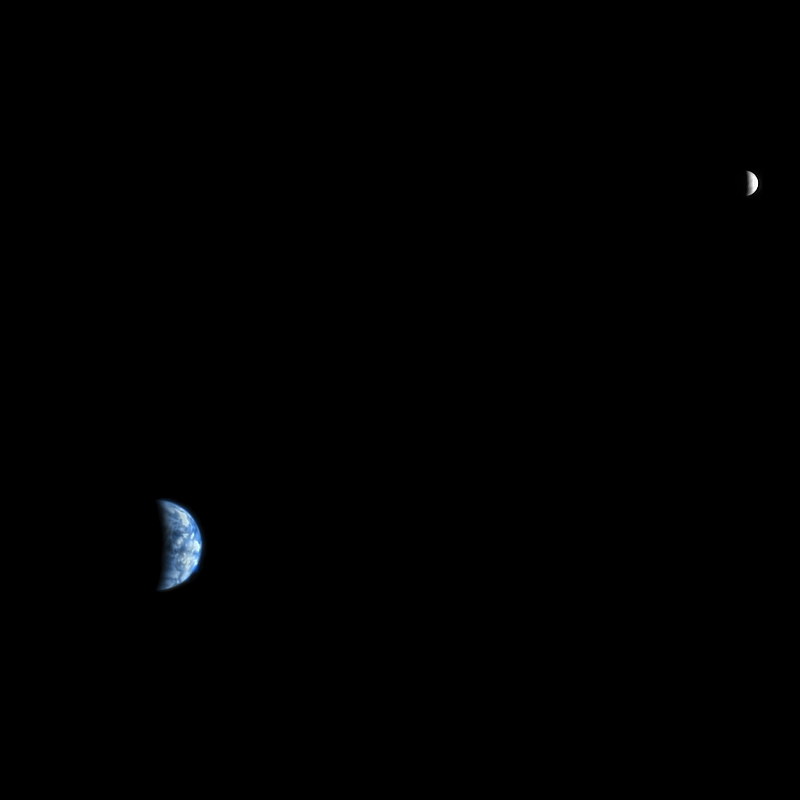
The Earth and Moon as seen from a probe orbiting Mars using a HiRes camera. Amazing.
Looks like progress. Here’s hoping.
Scientists have constructed a custom enzyme that reverses the process by which the human immunodeficiency virus (HIV) inserts its genetic material into host DNA, suggesting that treatment with similar enzymes could potentially rid infected cells of the virus. In tests on cultured human tissue, the mutated enzyme, Tre recombinase, snipped HIV DNA out of chromosomes.
An interesting discovery:
‘Planemos’ is a great word…
The pair belongs to what some astronomers believe is a new class of planet-like objects floating through space; so-called planetary mass objects, or “planemos”, which are not bound to stars.
They appear to have been forged from a contracting gas cloud, in a similar way to stars, but are much too cool to be true stars.
And while they have similar masses to many of the giant planets discovered beyond our Solar System (the largest weighs in at 14 times the mass of Jupiter and the other is about seven times more massive), they are not thought to be true planets either.
I had a listen to Off the Shelf yesterday, where they were reviewing Darwin’s Legacy by John Dupré. A really fascinating 30 minute discussion on creationism and evolution. Professor David McConnell, philosophy lecturer Fr. Brendan Purcell and presenter Andy O’Mahony are well worth listening to.
It’s just a matter of time before a smaller one is found…
An international team of astronomers has found the smallest Earth-like planet yet outside our Solar System.
The new planet has five times the Earth’s mass and can be found about 25,000 light-years away in the Milky Way, orbiting a red dwarf star.
…
The planet, which goes by the name OGLE-2005-BLG-390Lb, takes about 10 years to orbit its parent star, a red dwarf which is similar to the Sun but cooler and smaller.
It is in the same galaxy as Earth, the Milky Way, but is found closer to the galactic centre.
We are go for launch at 7pm GMT…watch it here.
I was all geared up to watch the New Horizons launch, and now its been scrubbed for another day :-(. Here’s hoping it lifts off tomorrow.
The vastness even of our own solar system is astonishing, that it would take just a year to get to Jupiter, and then another eight to get to Pluto gives you some sense of scale. Because of the orbits of the planets, this mission really has to go ahead before February 14th, or else the probe won’t arrive until 2020, rather then 2015. I will be about 34 when I read news of the probes arrival. Interesting side note…
It will be the fastest spacecraft ever launched, zooming past the moon in nine hours and reaching Jupiter in just over a year at a speed nearly 100 times that of a jetliner.
It still amazes me that humans can do this kind of thing, not only send things into space, but land them on objects like asteroids.
More on science and religion, the Kansas Board of Education has approved new public school science standards yesterday that cast doubt on the theory of evolution. Notes CNN:
The challenged concepts cited include the basic Darwinian theory that all life had a common origin and the theory that natural chemical processes created the building blocks of life.
In addition, the board rewrote the definition of science, so that it is no longer limited to the search for natural explanations of phenomena.
I just feel sorry for the students.
The BBC report on it here:
The new standards include several specific challenges, including statements that there is a lack of evidence or natural explanation for the genetic code, and charges that fossil records are inconsistent with evolutionary theory.
It also states that says certain evolutionary explanations “are not based on direct observations… and often reflect… inferences from indirect or circumstantial evidence”.
“This is a great day for education,” board chairman Steve Abrams told the Reuters news agency.
I think the phrase here is ‘flip-flop‘:
Cardinal Paul Poupard, head of the Pontifical Council for Culture, said the Genesis description of how God created the universe and Darwin’s theory of evolution were “perfectly compatible” if the Bible were read correctly.
His statement was a clear attack on creationist campaigners in the US, who see evolution and the Genesis account as mutually exclusive.
“The fundamentalists want to give a scientific meaning to words that had no scientific aim,” he said at a Vatican press conference. He said the real message in Genesis was that “the universe didn’t make itself and had a creator”.
Olivia Judson, an evolutionary biologist at Imperial College London has a piece on avian flu in today’s IHT. She notes:
The influenza virus that caused the infamous Spanish flu pandemic of 1918 had only eight genes - but it brought about more than 20 million human deaths. And alas, its lethality cannot be blithely attributed to wartime deprivation. For one thing, it was particularly deadly in young, healthy adults. For another, in a remarkable feat of genetic engineering, a team of biologists recently reconstructed the 1918 virus and used it to infect mice. The results are sobering. The 1918 virus is far, far more lethal in mice than are other human flu viruses.
H5N1 also has eight genes (by way of comparison, humans have about 20,000). So far, the virus’ effects have been more modest than those of the 1918 influenza: It has killed a lot of birds and about 60 people. That’s still worrying, however, because it has killed more than half of the people it has infected. For a virus, that is a high death toll.
My emphasis. There appears to be a conception out there that the very young and very old will be worse affected by an eventual flu pandemic, this is not necessarily the case.
She ends with a warning:
But the most important point is this: Viruses and other pathogens evolve in ways that we can understand and, to some extent, predict. Whether it’s preventing a flu pandemic or tackling malaria, we can use our knowledge of evolutionary processes in powerful and practical ways, potentially saving the lives of tens of millions of people. So let’s not strip evolution from the textbooks, or banish it from the class, or replace it with ideologies born of wishful thinking. If we do, we might find ourselves facing the consequences of natural selection.
Did anyone see Horizon last week? The study into epigenetics was fascinating, the theory that there may be much more to inheritance than mere DNA was thought provoking - can anyone recommend reading in this area?
More news on the avian flu front. It appears that the cases in Turkey have been confirmed as H5N1, meanwhile
The EU has banned all bird and poultry products from Romania after tests confirmed the presence of a strain of bird flu there. Duck samples tested positive for the H5 virus, contradicting earlier findings. But there is no evidence yet that the strain is the serious H5N1 variety, which has killed 60 people in Asia. Further tests will be carried out.
Another development on the avian flu front. I have not heard of any flu outbreaks in Turkey so I imagine this is a precautionary measure. The BBC notes:
The decision came after Turkish authorities slaughtered up to 2,000 birds in the north-west of the country in an effort to control the disease.
As many as 1,500 turkeys are said to have died on a farm in the region.
It has not yet been confirmed if it’s HN51.
It gets ever closer, and what has Ireland done to prepare? I’d hazard pretty much nothing.
Romanian officials quarantined a Danube delta village of about 30 people Friday after three dead ducks there tested positive for bird flu — the first such cases reported in the region.
Agriculture Minister Gheorghe Flutur said the virus found in the farm-raised ducks came from migrating birds from Russia.
And while it is difficult for the virus to spread from birds to humans, authorities were taking no chances. They sealed off the village of Ciamurlia and banned hunting and fishing in eight counties in the region.
Romania also suspended imports of chickens and other poultry from 15 countries, most of them in Asia.
How long do we have before a mututation occurs?
Yet another space tourist makes it to the ISS. He paid an estimated $20 million for the pleasure. I would hope that in my lifetime the price of a trip into orbit, not suborbit, will come down into the 5-figure bracket. It seems a little more likly with Space Ship Two on the way, and private investment into space technology increasing.
Dan Drezner links to some recent articles relating to avian flu, including the recent news that some strains of avian flu could be resistant to the antiviral drug Tamiflu. The figure of 7.4 million deaths globally as a result of a flu pandemic seem frightfully small to me. I have recently heard that Ireland has done practically nothing, and I am still awaiting word from the HSE. Time to start asking again.
Finally someone is quoting some figures (more reasonable to me anyway) that the inevitable flu pandemic could bring. Foreign Affairs had a special edition a while back on the avian flu threat, and back then I guesstimated a figure of 500 million was more likely than the figure of 20 million being suggested by most news sites. 150 milion would be 50 more than the 1918 pandemic, but I guess the outcome would be entirely dependent on how quickly the world’s governments cooperate and pull together to deal with it.
I never knew that Brazil had previously gone down the road of ethanol based fuel for cars.
Prompted by the oil shocks of the 1970s, Brazilian governments used laws and subsidies to promote ethanol-only cars, which had 90% of the market by the late 1980s. But supplies of sugar-based fuel dried up suddenly when planters rushed to meet a surge in demand for sugar. Sales of ethanol-powered cars dropped to nearly zero by 1990—one taxi driver famously set his alight outside Congress.
Flex-fuel cars have persuaded Brazilians to give ethanol a second try. The initiative came from the Brazilian operations of parts suppliers such as Magneti Marelli, owned by Fiat of Italy, and Bosch, a German company. They persuaded the government to extend to flex-fuel cars the tax break previously applied to ethanol-only models. Volkswagen was first to the market, followed quickly by other big manufacturers.
Ford announced this week that flexi-fuel based cars will go on sale in Ireland in November. Ford are hoping that Brian Cowen will give tax breaks on bio-ethanol based cars. They have already proved very popular in Scandanavian countries. However flexi-fuel in Ireland will apparently be produced from the waste made during certain dairy processes, a product known as bio-ethanol. I am not sure if that produced from sugar is better or worse.
Why does this not surprise me. I suppose I should be grateful they are doing something.
The Department of Health is expected to tell the Government’s Working Group on Emergency Planning tomorrow that it will be next year before it has the one million packs of anti-viral drugs which international trends suggest would be best practice for preparing to deal with the emergence of any flu pandemic.
Separately, Department of Health officials are expected to warn that planning for a global flu pandemic, while aiming to reduce the rates of death and illness, can only mitigate the effects of the outbreak and that the consequences were still likely to be serious.
The Department of Health is expected to tell the working group that in the event of a pandemic, anti-viral drugs could be used to prevent influenza in the early stages, alleviate symptoms or shorten the duration of the condition, but that the production of a vaccine tailored to a specific strain could take six to nine months.
The department is also expected to tell the working group that it is also set to procure around 200,000 doses of the H5N1 vaccine against the avian influenza strain implicated in the recent outbreak in Asia.
The working group, chaired by Minister for Defence Willie O’Dea, is to deal with official preparations for a major international flu pandemic at its meeting tomorrow.
Willie O’Dea? Is that not like putting Michael Brown in charge of FEMA, or worse?
Well hopefully I will see this in my lifetime, to think we have left it so long before going back is strange. But I think there are reasons other than scientific here, space will become a very important place in the next few decades, and controlling it will be pretty important, the US appears to even want to control the strategically important LaGrange points (PDF).
Go and add your name to a list being put on a CD and being sent to Pluto, it will arrive there in 2015.
This is a very interesting development. It seems that H5N1 is being taken even more seriously than before:
Every doctor’s surgery in Britain will next month be sent official instructions on how to handle an outbreak of bird flu as ministers step up their preparations for a global pandemic that, if the worst fears are borne out, could kill up to 50m people.
The UK’s 10,465 surgeries will receive a package of information from the government to help tackle a flu pandemic, which scientists warn is now inevitable. Ministers and officials have privately expressed the view that a bird flu pandemic poses a greater threat than terrorism.
The Department of Health says up to 50m people could die worldwide, of whom between 50,000 and 650,000 would be in the UK.
That’s quite a range isn’t it? In other words they really have no idea how many people it could kill. I think 50 million globally is quite conservative too.
And whither Ireland’s response? I guess some copying of UK policy as usual….
This is getting more serious with H5N1, is it a matter of time before it becomes a human-human strain? And what happens if it does?
The first cases of bird flu have been reported in the Chelyabinsk region of Siberia, near the Ural mountains separating Europe from Asia. Scientists don’t yet know whether the deadly H5N1 strain is involved.
Roads were cordoned off and hundreds of chickens slaughtered in Chelyabinsk yesterday to contain the apparent advance of avian flu, first reported in Siberia in July and spreading west via migrating birds.
The H5N1 strain of avian flu has led to the death from infection and culling of tens of millions of birds across South-East Asia. It has also infected 112 people in Thailand, Vietnam, Cambodia and Indonesia, causing 57 deaths. Russia has not yet experienced any cases of affected human beings.
Scientists are concerned the H5N1 strain could mutate and pass easily between people. Were that to happen, it could potentially trigger a pandemic such as the 1918-19 Spanish flu which killed 20 million to 40 million people.
The Shuttle is coming home but to California instead of Florida. I hope they all make it home safely.
Kevin Drum is reminding some of those on the right about Bush’s views on evolution and creationism - apparently some of them forgot.
Actually, what bugged me most about this whole affair was reading the faux outrage from Bush’s conservative supporters in the blogosphere, as if they had no idea he felt this way before this week. Give it a rest, guys. Bush thinks creationism sounds great, Tom DeLay thinks the teaching of evolution was responsible for the Columbine shootings, and Bill Frist — a medical doctor! — is so scared of the Christian right that last December on “This Week” he hemmed and hawed and fidgeted like a naughty schoolchild while repeatedly declining to say whether he thought HIV-AIDS could be transmitted through tears or sweat.
The venerable Dan Drezner also weighs in, I agree with him.
So Discovery made it, but some debris appeared to miss damaging any parts of the shuttle. I remember posting about the aftermath of the disaster, it is great to see the shuttle back up, even if the shuttle program expires in 5 years time.
I rather liked this story from last week’s Economist. It concerns risk aversion in humans and monkeys.
When buying things in a straight exchange of money for goods, people often respond to changes in price in exactly the way that theoretical economics predicts. But when faced with an exchange whose outcome is predictable only on average, most people prefer to avoid the risk of making a loss than to take the chance of making a gain in circumstances when the average expected outcome of the two actions would be the same.
…Keith Chen, of the Yale School of Management, and his colleagues decided to investigate its evolutionary past. They reasoned that if they could find similar behaviour in another species of primate (none of which has yet invented a cash economy) this would suggest that loss-aversion evolved in a common ancestor. They chose the capuchin monkey, Cebus apella, a South American species often used for behavioural experiments.
So the experiment was carried out as follows:
First, the researchers had to introduce their monkeys to the idea of a cash economy. They did this by giving them small metal discs while showing them food. The monkeys quickly learned that humans valued these inedible discs so much that they were willing to trade them for scrumptious pieces of apple, grapes and jelly.
Preliminary experiments established the amount of apple that was valued as much as either a grape or a cube of jelly, and set the price accordingly, at one disc per food item. The monkeys were then given 12 discs and allowed to trade them one at a time for whichever foodstuff they preferred.
Once the price had been established, though, it was changed. The size of the apple portions was doubled, effectively halving the price of apple. At the same time, the number of discs a monkey was given to spend fell from 12 to nine. The result was that apple consumption went up in exactly the way that price theory (as applied to humans) would predict. Indeed, averaged over the course of ten sessions it was within 1% of the theory’s prediction. One up to Cebus economicus.
The experimenters then began to test their animals’ risk aversion. They did this by offering them three different trading regimes in succession. Each required choosing between the wares of two experimental “salesmenâ€?. In the first regime one salesman offered one piece of apple for a disc, while the other offered two. However, half the time the second salesman only handed over one piece. Despite this deception, the monkeys quickly worked out that the second salesman offered the better overall deal, and came to prefer him.
In the second trading regime, the salesman offering one piece of apple would, half the time, add a free bonus piece once the disc had been handed over. The salesman offering two pieces would, as in the first regime, actually hand over only one of them half the time. In this case, the average outcome was identical, but the monkeys quickly reversed their behaviour from the first regime and came to prefer trading with the first salesman.
In the third regime, the second salesman always took the second piece of apple away before handing over the goods, while the first never gave freebies. So, once again, the outcomes were identical. In this case, however, the monkeys preferred the first salesman even more strongly than in the second regime.
What the responses to the second and third regimes seem to have in common is a preference for avoiding apparent loss, even though that loss does not, in strictly economic terms, exist. That such behaviour occurs in two primates suggests a common evolutionary origin. It must, therefore, have an adaptive explanation.
What that explanation is has yet to be worked out. One possibility is that in nature, with a food supply that is often barely adequate, losses that lead to the pangs of hunger are felt more keenly than gains that lead to the comfort of satiety. Agriculture has changed that calculus, but people still have the attitudes of the hunter-gatherer wired into them. Economists take note.
And yes I would be much more pro-nature as oppose to nurture.
It is a scenario that may seem sci-fi, but it could happen.
NASA’s Mars Exploration Program Analysis Group this month issued a report on research needed to certify the safety of such a Mars mission.
One of the panel’s top priorities goes well beyond the scope of any mission in NASA’s current plans. The panel concluded that no amount of robotic testing on Mars could rule out the possibility of living microbial life at future human landing sites.
So astronauts could inadvertently bring the life back to Earth, with potentially dangerous consequences. “The possibility of transporting a replicating life form to Earth, where it is found to have a negative effect on some aspect of Earth’s ecosystem” would present the greatest biological risk, the team wrote.
News like this will become much more frequent in the next few years - until that one day, probably in my natural lifetime, when we will discover a pale blue dot. What do we do then, and what effect will it have on humanity?
But the new “super-Earth� is by far the smallest planet seen circling a commonplace star. The team discovered it while observing a star called Gliese 876 from the Keck Observatory in Hawaii. Gliese 876 is a red dwarf, one-third of the mass of the Sun, and lies just 15 light years away in the constellation Aquarius.
Just in case you thought our galaxy was pretty big, it turns out that our neighbour Andromeda is huge…
The Andromeda galaxy, the most familiar of all the starry pinwheels in the sky and the Milky Way’s virtual twin, is three times the size astronomers had thought….the disc of the galaxy is actually three times larger than had been thought - 220,000 light years across, instead of previous estimates of 70,000 to 80,000.
Things could get hairy - expect some satellites to stop working. It is a 9 on the K-index. Or in other words, hold onto your hats:
Possible impacts from such a geomagnetic storm include widespread power system voltage control problems; some grid systems may experience complete collapse or blackouts. Transformers may experience damage. Spacecraft operations may experience extensive surface charging; problems with orientation; uplink/downlink and tracking satellites. Satellite navigation may be degraded for days, and low-frequency radio navigation can be out for hours. Reports received by the NOAA Space Environment Center indicate that such impacts have been observed in the United States.
Got this one via the Irishblogs yahoo list, what on earth is it? Or is it even from Earth?
I don’t know whether to be happy or sad about this - I have been looking forward to the TPF for years now. Then again, if they can save hubble…
But funding the Hubble mission would mean the indefinite postponement of two future missions to search for extrasolar planets - the Space Interferometry Mission, which had been scheduled for 2011, and the Terrestrial Planet Finder, which was set to launch in 2014. And he said the agency was considering delaying the next rover mission to the Red Planet, called the Mars Science Laboratory, from 2009 to 2011.
“We have to have priorities,” Griffin said, adding that reducing budgets across all programmes or eliminating funding in the middle of existing projects “is not an effective way to save money. I would look to delaying programmes that have not yet started.”
Everything is not going so smoothly, but hopefully this will be ironed out.
Deployment of a radar on Europe’s Mars Express spacecraft has been delayed after the antenna boom released on Wednesday did not fully straighten out. Officials said 12 out of 13 segments that comprise the first boom had deployed successfully, but segment 10 was not fully locked into place.
Fascinating news from the cosmos:
A faint visible-light flash moments after a high-energy gamma-ray burst likely heralds the merger of two dense neutron stars to create a relatively low-mass black hole, said Neil Gehrels of NASA’s Goddard Space Flight Center. It is the first time an optical counterpart to a very short-duration gamma-ray burst has ever been detected.
Don’t forget that Gamma-Ray Bursts are the biggest known explosions in the universe, and are one of this things that could wipe out life on earth, if we were close enough.
I failed to blog this last week, anyway it’s worth mentioning - the Economist have a piece on it. Not read up on fusion?
In principle, nuclear fusion is a simple process. All you have to do is push two suitable atomic nuclei close enough together for them to overcome their mutual electrical repulsion (since both are positively charged) and they will merge. This merger releases oodles of energy. The usual way to push nuclei together is to smash them into one another at high speed. In thermonuclear fusion (the sort that happens in the sun, in hydrogen bombs, and in traditional fusion experiments) that speed is achieved by heating the atoms up. But this, as Dr Naranjo and his colleagues realised, is not the only way to do things. You can, as they have done, simply accelerate a stream of nuclei to high velocity, and fire them into a stationary target.
And the experiment…
Dr Naranjo, by contrast, has devised a compact way of generating high voltages at much lower power using a so-called pyroelectric crystal.
Heating such a crystal (or, rather, warming it from -30°C to just above freezing point) deforms its structure in a way that concentrates positive charge in one place and negative charge in another. That results in a big voltage between the two. The researchers then amplified the effect of the positive charge by attaching a metal tip to the place where it was accumulating. This concentrated the electrical field in the same way that the point of a lightning conductor concentrates the stroke.
Dr Naranjo used this effect two ways: first to strip deuterium atoms of their electrons and second to repel the resulting stream of deuterium nuclei at high speed towards a target containing more deuterium. When two deuterium nuclei (each composed of a proton and a neutron) fuse, the result is a type of helium composed of two protons and a neutron, a free neutron, and a lot of energy. The bombardment also produces a lot of X-rays. By counting the neutrons and measuring the X-rays the researchers estimate that about 1,000 pairs of deuterium nuclei were fusing every second.
This is, as they are the first to admit, a long way from producing a significant amount of energy. And although they reckon they could boost the fusion rate 1,000-fold with better apparatus, that still might not reach the magic threshold of producing more energy than it takes to run the experiment. Beyond that, they are understandably unwilling to speculate.
I am really looking forward to the results from this:
The Mars Advanced Radar for Subsurface and Ionosphere Sounding (MARSIS) instrument consists of three long fibreglass tubes strung with wires that will bounce radio waves off the planet. Some waves will penetrate the surface – potentially revealing oases of water, in liquid or ice form - lurking a few kilometres underground.
What’s the betting that they will find alot of water? And don’t forget, NASA launch a probe to Mars, the Mars Reconnaissance Orbiter, later this Summer.
It seems that the trauma of September 11 lives on:
A study of 38 women who witnessed the World Trade Center attacks was carried out by researchers from the University of Edinburgh in Scotland, UK, and the Mount Sinai School of Medicine in New York, US, one year after the events. Cortisol levels were lower than expected in those women who experienced PTSD in response the attacks - and also in their children.
“Because the babies were about a year old at the time of testing, this suggests the trauma effect transfer may have to do with very early parent-child attachments, cortisol ‘programming’ in the womb, or shared genetic susceptibility,” says Jonathan Seckl, of the University of Edinburgh.
The Guardian have a good roundup of ways humanity could be wiped out, they use Sir Martin Rees’ stuff as a basis:
1: Climate Change
2: Telomere erosion
3: Viral Pandemic
4: Terrorism
5: Nuclear war
6: Meteorite impact
7: Robots taking over
8: Cosmic ray blast from exploding star
9: Super-volcanos
10: Earth swallowed by a black hole
An alien asteroid belt may have been spotted circling a mature star nearby. The observations, made by NASA’s Spitzer Space Telescope, reveal a dense ring of dust around the star that might arise from rocks colliding and smashing each other apart.
Alternatively, the dust could come from a “supercomet� almost the size of Pluto, said Charles Beichman of the California Institute of Technology in Pasadena, US, at a NASA news conference on Wednesday.
Beichman and his colleagues used Spitzer to observe more than 80 Sun-like stars, including one called HD69830, which lies 41 light years away. Its infrared spectrum suggested it has a thick disc of warm dust grains surrounding it. The dust could be produced in a busy asteroid belt if large rocks are colliding every 1000 years or so, replenishing the ring.
And it could indicate planets in orbit. And we might even be able to freeze ourselves to make the long trip.
Could Mars be biologically active? We might have to wait until humans go there to get a definitive answer.
This one for all the free-market lovers out there:
Modern humans may have driven Neanderthals to extinction 30,000 years ago because Homo sapiens unlocked the secrets of free trade, say a group of US and Dutch economists. The theory could shed new light on the mysterious and sudden demise of the Neanderthals after over 260,000 years of healthy survival.
John has helpfully pointed out that news has emerged of the ‘First directly imaged and confirmed companion to a sun-like star’.
Exciting times, and only a matter of time before the technology of telescopes will improve so we can see the planets in much greater detail.
I have to hand it to them, it is a good idea.
Japan’s prime minister plans to dress down this summer, and wants millions of Japanese office workers to do the same. Junichiro Koizumi is asking workers to cast off their collars and ties in a national effort to use less energy on air conditioning. To show how serious he is, Mr Koizumi has ordered government ministers to shed their suits to set an example. Japan often endures hot, humid summers, forcing offices and bars to ramp up air-conditioning systems.
Kevin Drum has been given a curious assignment…in relation to an impending debate on an apparently growing number of scientists around the world who no longer believe that natural selection or chemistry, alone, can explain the origins of life.
…please prepare suitably relevant definitions for the following words and phrases:
*”Growing number”
*”Scientists”
*”Believe”
*”Theory”
*”Compelling”
*”Biochemical”
*”Evidence”
Hmm. I am always sceptical when I hear a phrase like “provides evidence of purpose and design in nature”. This subject has come up before - I just don’t think it holds water. But please convince me with sound evidence of design (implying a designer) and evidence of the existence of such a designer and I will be satisfied.
This is all over the Internet, the BBC do a good job of rounding it up.
The most comprehensive survey ever into the state of the planet concludes that human activities threaten the Earth’s ability to sustain future generations. The report says the way society obtains its resources has caused irreversible changes that are degrading the natural processes that support life on Earth. This will compromise efforts to address hunger, poverty and improve healthcare. The Millennium Ecosystem Assessment was drawn up by 1,300 researchers from 95 nations over a period of four years. It reports that humans have changed most ecosystems beyond recognition in a dramatically short space of time.
And so it begins. For the first time light has been captured from two known planets orbiting stars other than our Sun. Within the next decade we will likely see new arrays of space telescopes built, that will not only be able to identify extra solar planets, but will be able to photograph and catalogue them. And at some point, it may take a picture of a green and blue dot circling a distant star. What do we do then?
Here is some interesting reading for a Sunday evening, the top 13 things in science that don’t really make sense. For example the Belfast homeopathy results.
MADELEINE Ennis, a pharmacologist at Queen’s University, Belfast, was the scourge of homeopathy. She railed against its claims that a chemical remedy could be diluted to the point where a sample was unlikely to contain a single molecule of anything but water, and yet still have a healing effect. Until, that is, she set out to prove once and for all that homeopathy was bunkum.
In her most recent paper, Ennis describes how her team looked at the effects of ultra-dilute solutions of histamine on human white blood cells involved in inflammation. These “basophils” release histamine when the cells are under attack. Once released, the histamine stops them releasing any more. The study, replicated in four different labs, found that homeopathic solutions - so dilute that they probably didn’t contain a single histamine molecule - worked just like histamine. Ennis might not be happy with the homeopaths’ claims, but she admits that an effect cannot be ruled out.
So how could it happen? Homeopaths prepare their remedies by dissolving things like charcoal, deadly nightshade or spider venom in ethanol, and then diluting this “mother tincture” in water again and again. No matter what the level of dilution, homeopaths claim, the original remedy leaves some kind of imprint on the water molecules. Thus, however dilute the solution becomes, it is still imbued with the properties of the remedy.
You can understand why Ennis remains sceptical. And it remains true that no homeopathic remedy has ever been shown to work in a large randomised placebo-controlled clinical trial. But the Belfast study (Inflammation Research, vol 53, p 181) suggests that something is going on. “We are,” Ennis says in her paper, “unable to explain our findings and are reporting them to encourage others to investigate this phenomenon.” If the results turn out to be real, she says, the implications are profound: we may have to rewrite physics and chemistry.
And who said homeopathy was all bunkum?
Some more fuel to the climate change debate:
Meehl and his colleagues used two sophisticated computer models of global climate to predict what would happen under various scenarios for greenhouse gas emission controls, taking into account the oceanic time lag. Their most optimistic scenario - in which atmospheric concentrations of greenhouse gases are capped at year 2000 levels - would require severe cuts in CO2 emissions, far beyond those set in the Kyoto protocol.
But even this optimistic scenario predicts that global temperatures would continue to rise by between 0.4°C and 0.6°C over the next century. That increase is comparable to the increase in global temperature during the 20th century of about 0.6°C. A second, independent study using a simpler climate model by Tom Wigley, another climatologist at NCAR, paints the same bleak picture.
This story has been doing the rounds, including Caoimhe and Insta.
I have watched several documentaries on American Airlines flight 587, people may remember it as the first crash in the US after September 11. It apparently was all down to pilot’s training, or being trained incorrectly. Over-using peddles in the cockpit, pilots were inadvertently placing too much stress on the tail rudder and during what may have been wind sheer in New York, the pilot unwittingly placed a huge amount of stress on the the tail rudder, causing it to fall off. But the saftey of composite materials in Airbus’ was brought into question - and remains a sore issue. The plane crashed into houses in Queens. But that was on the Airbus A300, this latest incident is on the A310. Is there an inherent design flaw?
As someone with several relatives working in airline industries, I am very concerned indeed.

The above photograph was taken by the first Earthlings to visit Titan after the recent catastrophic nuclear war. As we now know there were no survivors of the horrific conflict. The age old and proud Titan civilization is no more.
At centre left can be seen the ground zero impact point, this had such a devastating affect that it wiped out nearly all signs of the once great Titan capital city of Titanville. Some of the signs that remain include the main highway from the West. (Right of picture). At centre left the remains of the ancient wall that was critical in repelling the invasion of the hated Borg. The remains of the harbour wall can be observed just in front of ground zero. The harbour that once afforded safe anchorage to the great Titan navy, principally responsible for the creation of the all powerful Titan Empire. Ironically, the only building that is in any way recognizable is the Senate house where the decision to go to war was made. (Above the harbour and to the right of ground zero).
Nobody knows exactly what triggered the conflict. However, last year a major study by Earth scientists concluded that although the Titans were well advanced technologically, their intelligence capability had not evolved enough to allow them to see that their focus on short term self-interest could be fatal to their long-term survival.
Anthony Sheridan
Via Slashdot, the ESA probe Smart-1 will image the Apollo sites, this might put to rest certain conspiracy theories.
The ESA probe Rosetta has taken more spectacular images of Earth.